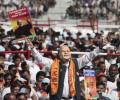
'The Congress era was already over anyway! The real question is: Has India opened a new, post-coalition era and I'm very doubtful about that,' Christophe Jaffrelot, author of several books on Indian politics, tells Archana Masih/Rediff.com, analysing Mandate 2014.
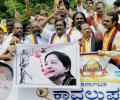
Verifiable 'distress-sharing' of available water may still be the way out of the Cauvery water row, says N Sathiya Moorthy.
Delhi's inability to open up a new canvas with Pakistan and Sharif is symptomatic of its sluggish thinking. Jyoti Malhotra analyses

From early indications, the Modi government's foreign policy seems to be pragmatic and reciprocal, says K G Suresh.

'Building on the potential for closer ties is the changing narrative in each country about the other. The Chinese narrative on India has become significantly more positive over the past few years,' says Walter Andersen and Zhong Zhenming.
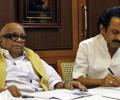
M K Stalin might not have his father's charisma, but he has learnt the ropes the long, hard way, says T E Narasimhan

'As the first leaders of their respective countries born after Indian Independence and the Chinese Liberation, Modi and Xi would be expected to have the ability to overcome the traditional mindsets and the hierarchical nature of their official/bureaucratic establishments,' say Alka Acharya and Jabin T Jacob.

One thing Beijing must understand is that India is not obsessed with being a threat to China but only wants a rightful place for itself in the world, says Sanjeev Nayyar.

B S Prakash takes a tongue-in-cheek look at what India's neighbours think about the proposal of a SAARC satellite.

Arvind Singh, a member of Mahabodhi temple management committee, said the two injured included a national of Myanmar and another of Tibet. They have been admitted to the Magadh MedicalCollege and Hospital, he said
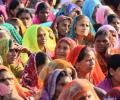
The perception that 'winnability' is based on gender is very strong, even though, if you break up the electoral success rate by sexes, the women who do win elections are proportionally far more successful than the men who win, given the huge number of men they have to beat.
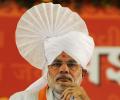
The second and final part of former cabinet secretary Naresh Chandra's interview to Sheela Bhatt.

'Modi has entered blunderland as he does not understand the army. He has actually meddled with the army, which is much more damaging than the ignorance of Sonia Gandhi and Manmohan Singh.' 'People had an impression that the BJP was different. Now it has been made very, very, plain that it is not.' 'Look at the contrast in the behaviour of the prime minister. When they burnt buses in Gujarat for an unjust demand, the prime minister addressed them in Gujarati while the army veterans were on relay hunger strike for the 74th day on that day, but no word on this from the PM.'

There is no alternative for the party and the state to wait for CM Jaya to return home as CM Jaya, and make her call, says N Sathiya Moorthy.

The success story of Adani's Mundra Port in Gujarat, in terms of efficiency, technology and management, should be replicated at Vizhinjam to ensure that this ambitious project does not fail, say Shehzad Poonawalla and Riya Sinha.

The main culprit in vitiating the inter community/caste/class relations has been the so called 'targeted' approach. This is nothing but discrimination on the basis of faith/caste/class. When an equally poor and deprived child is denied scholarship, despite equal merit, resentment begins to brew, says Colonel (retd) Anil Athale.

'In her insecurity, she destroyed the institutions of democracy.' 'She packed Parliament with her supporters with loyalty being more important than ability; she superseded judges; she corrupted the civil service.' 'She knew how to use people against each other and was quite a master of that.' 'She would do this with calculated skill and in the bargain cause enmity between brothers, split up families.'
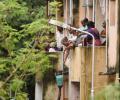
Rains will continue to batter Tamil Nadu for the next seven days and the next 48 hours are "very crucial", the IMD has said.

Obama's decision to visit India must be a result of his judgement that Modi is a man of action, feels Ambassador T P Sreenivasan.

Despite a lot of lip service to national unity, functional relations between the Han Chinese immigrants and the Uyghur regional majority have not developed on equitable basis, says R Hariharan

'The book has immense value because it reveals the inner workings of the think-tank which appears to provide facts and insights to Modi, though he himself takes the final decisions and articulates them in his characteristic rhetorical style,' says Ambassador T P Sreenivasan.

The veshti controversy in Tamil Nadu is not about the dress -- but a dress-code, which seems permissible in private homes and offices, but not in private clubs that are open only to well-heeled, and well-paying private members, observes N Sathiya Moorthy

PM Modi seems to be gradually ending India's strategic ambiguity

'A plausible American tactic,' Rajeev Srinivasan suspects, 'would be to try and prevent the BJP and Modi from coming to power by splitting the anti-Congress vote using the AAP, and in case that fails, to follow up with a Plan B to make India ungovernable, to create mass conflict through their agents.'

Mark Tully on the India he loves.

Can you find a world leader who has met generations of Indian politicians, most US Presidents, European head of States, several Popes, celebrated cricketers, Hollywood and Bollywood stars, some of the greatest scientists and many ordinary people, including what he calls, 'Chinese brothers and sisters?'

He will now have to submit to the two-year jail term handed down to him.

How to deal with a country that has made export of terror a reason to make the world notice and fund it? Rediff.com contributor Sanjeev Nayyar offers a few suggestions
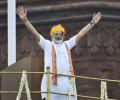
Following is the full text of Prime Minister Narendra Modi's address from the ramparts of the Red Fort on the 73rd Independence Day.

The roots of the problem lies in the alienation of the tribals. Extreme sensitivity is required to tackle the issues involved. Rough and ready methods of using force may prove counterproductive in the long run, says Colonel (retd) Anil Athale.

Those who know Shiv Shankar Menon will vouch that he did lots of things, substantial in the immediate neighbourhood and widespread in South Asia, but without making things public. Twenty per cent of Menon's job was visible, while 80 per cemt of his job was not known to the public, says Sheela Bhatt/Rediff.com

The IPL, all of a sudden, may have some catching up to do with the Big Bash.
Chartered accountant and commentator M R Venkatesh on why the GST Bill will cost the BJP dear.

Do Modi's foreign visits actually serve India or they nothing more than expensive tools for domestic positioning and image-building, asks Shehzad Poonawalla.

For all the blame-game over the flood preparedness in Chennai and elsewhere in Tamil Nadu and Puducherry, this is not the first of its kind. Nor would it be the last, given the nature of the north-east monsoon, says N Sathiya Moorthy.

The year 2014 has been an eventful one for India. The country got a new government and a new state, broke new frontiers in various fields and of course its share of controversies.

The euphoria of Ab Ki Baar Modi Sarkar will fade quickly if the Modi government does not raise its game, and focus significant monetary resources and managerial skills on making India's infrastructure truly world-class, says Ram Kelkar.

'... A youth movement which could really transform our politics in a way that the existing elites don't understand.' 'The more you suppress free expression, the more people will value it.' 'The State can't suppress a young society like India where there are so many interesting new ideas emerging,' says Sunil Khilnani, whose latest book Incarnations looks at Indian history through 50 lives.
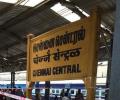
How far did the existing air of permissiveness may have contributed to those like the Indian Mujahideen targeting Tamil Nadu for setting up base, is a question that the state's law and order machinery would have to ask itself, and stall them on the track and for good, says N Sathiya Moorthy

'India should think big: About how in a multi-polar world, India can indeed be one of the poles, rather than being a secondary power that has to worry about 'alignment' with one of the poles. A G3 in other words, India should look to getting others to align with itself rather than the US or China,' says Rajeev Srinivasan.
 © 2026 Rediff.com - Advertise with us - Disclaimer - Privacy Policy - Sitemap - Feedback - About us - Terms of use - Grievances